
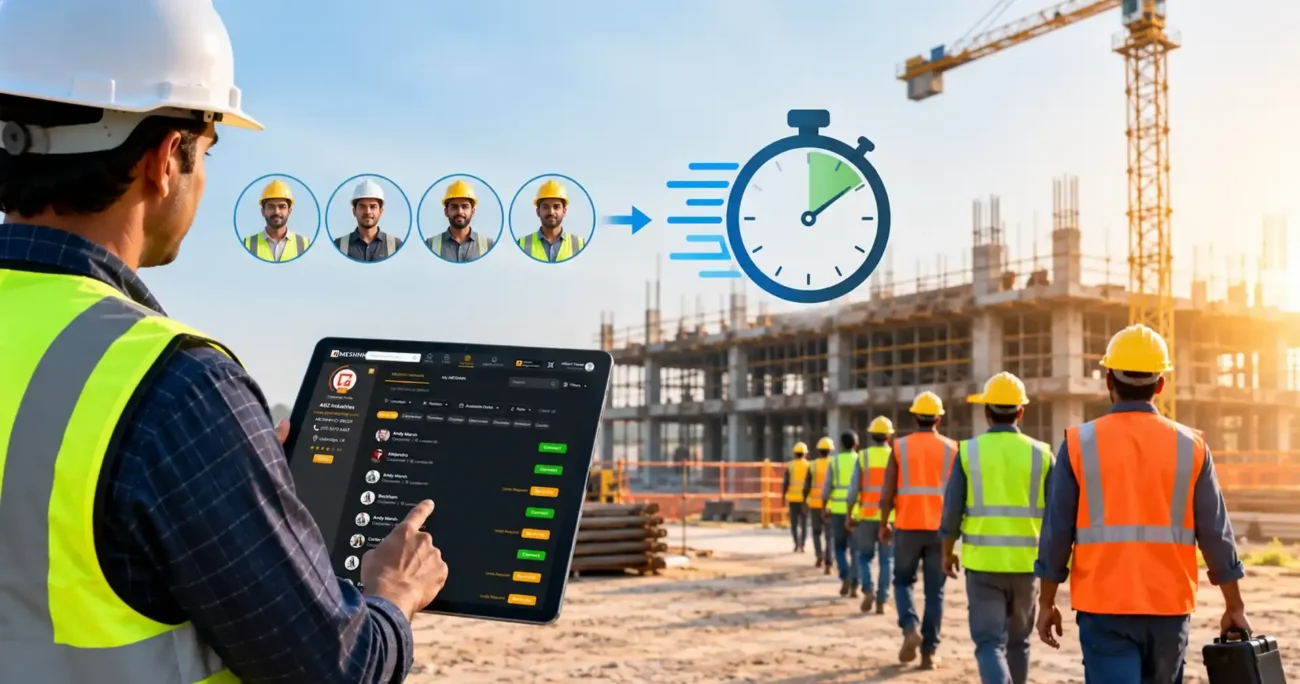
There’s a line item that appears on no programme, in no budget, on no dashboard: the hours spent finding people. Calls that don’t connect. Messages that get a reply two days late. The same conversation, fresh, every time.
Because it’s invisible, it never gets managed. Which is a shame, because labour sourcing is one of the most compressible time costs on a project, if you treat it as a process rather than a series of emergencies.
The construction industry’s wider reliance on manual processes is part of the problem, as explored in why construction is one of the least digitised industries.
For one week, keep an honest tally of the time spent sourcing: every call, every chase, every “any good groundworkers going spare?” message. Most PMs who actually do this are surprised. You can’t shrink a cost you’ve never measured, and this one hides in five-minute chunks all day long.
The biggest time sink isn’t finding good people, it’s re-finding them. If every gap starts with a blank contacts list and a memory test, you’re solving the same problem repeatedly. A maintained pool of people you’ve already vetted turns most sourcing jobs into a lookup instead of a search.
Knowing how to find reliable tradespeople also helps you build a stronger pool from the start, rather than repeatedly sorting through unverified contacts whenever a project needs extra labour.
No PM orders concrete the morning it’s needed, but plenty leave labour to exactly that timescale. The trades you’ll need in three weeks are knowable now. Checking availability ahead, while people can still say yes, costs minutes. Doing it in the morning costs your whole morning.
Building relationships before you urgently need someone also makes this easier. A tradesperson with a clear professional profile gives project teams useful information before the first conversation even takes place.
Credentials, CSCS level, photos of previous work, references, if these get checked ad hoc, over the phone, they get checked slowly and inconsistently. A profile that already holds this information turns twenty minutes of questions into a two-minute read, done before you’ve even made contact.
Right-to-work verification should also be part of a consistent process. Understanding right-to-work checks for construction workers can help teams avoid leaving essential checks until the last minute.
A phone call is one conversation at a time, and half of them go to voicemail. A direct message to five available people takes the same two minutes and works while you get on with the day. Save the call for the person who’s already said yes.
This becomes even more useful as a reliable tradesperson moves from working alone to taking on additional people. The shift from sole trader to team can create a wider pool of available skills, provided those relationships are managed properly.
None of this asks you to lower the bar on who gets on site. It asks you to stop paying the same sourcing cost twice, because most of the time you spend finding people is really time spent re-finding people you’d already found.
That is why maintaining skills and relationships matters just as much as sourcing people in the first place. Upskilling in construction can help broaden the capabilities available within your existing network, while a focus on building trust and reputation as a tradesperson can make those relationships more dependable over time.